Zirconia Grinding Beads
The bead is half the process. A 0.1 mm bead costs roughly four times what a 0.5 mm bead does per kilogram, wears faster, and sets a hard floor on the fineness you can reach. Choosing media is a cost decision, not an accessory purchase.
Which bead reaches which fineness — and what it costs
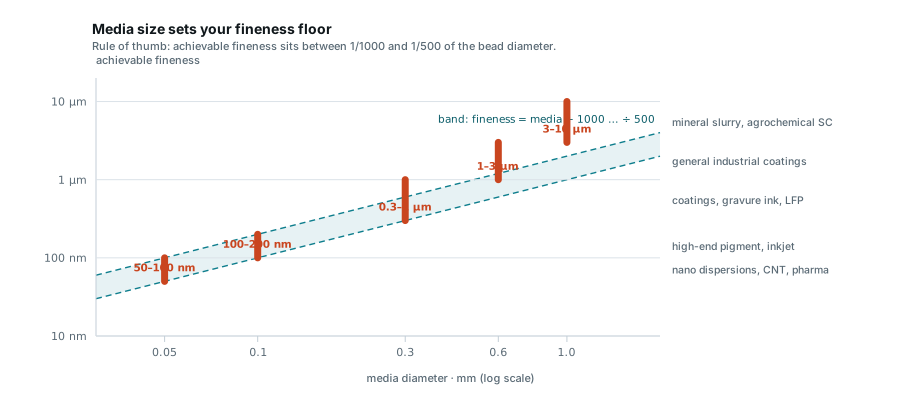
Media diameter sets a floor on achievable fineness at roughly 1/1000 to 1/500 of the bead diameter. No tip speed, no pass count and no machine upgrade moves that floor. So the size is decided by your specification, and the cost follows from the size.
| Bead size | Achievable D90 | Fits | Cost index | What it is for |
|---|---|---|---|---|
| 0.03 – 0.05 mm | D90 30 – 100 nm | PM-NX only | 6.0 | Centrifugal separator required — no screen or gap will hold media this small |
| 0.1 – 0.15 mm | D90 100 – 200 nm | PM-NX, PM-NP | 3.9 | The workhorse size for sub-200 nm pigment, inkjet and battery work |
| 0.2 – 0.3 mm | D90 200 – 400 nm | PM-NP, PM-NT | 2.4 | Where most nano projects actually belong; cheapest route under 400 nm |
| 0.3 – 0.4 mm | D90 0.3 – 1 µm | PM-NP, PM-MP | 1.2 | The crossover point between nano and micron economics |
| 0.4 – 0.8 mm | D90 1 – 3 µm | PM-MP, PM-MD | 1.00 | Baseline size. Cheapest per kilogram, and the default for coatings |
| 1.0 – 1.2 mm | D90 3 – 10 µm | PM-MP, PM-MD | 1.05 | General industrial and mineral work; wears slowly |
| 1.5 – 3.0 mm | D90 10 – 30 µm | PM-MD, PM-X | 1.15 | Pre-grinding and coarse work; not a fineness tool |
Cost index is relative to the 0.4 – 0.8 mm size, set at 1.00. It is calculated from published list prices for one 95% Y-TZP grade and is stable enough to plan with, but it is a ratio, not a price — ask for a quotation at the size you actually need. Note the shape of the curve: below 0.3 mm the cost climbs steeply, and above 1.5 mm it climbs again.
Five materials, and when each one is a mistake
Density and wear rate are the only two numbers that matter, and they trade against price. The cheap grades are cheap for a reason that shows up in your product, not in your maintenance budget.
| Grade | Density g/cm³ | Wear vs Y-TZP | Cost vs Y-TZP | When it is the right choice |
|---|---|---|---|---|
| Y-TZP, 95% ZrO₂ | 6.0 | 1.0 | 1.0 | The default below 1 µm. Yttria-stabilised, tetragonal phase — the toughness is what stops it shattering. |
| Ceria-stabilised zirconia | 6.2 | 1.1 | 0.6 | Cheaper and slightly softer. Fine for pigment and ink; it will not survive hard minerals at high tip speed. |
| Zirconium silicate | 4.0 | 2.0 | 0.25 | Only above 5 µm. Cheap, but the wear goes into your product as silica — a problem for electronics and optical work. |
| Alumina | 3.6 | 3.0 | 0.3 | Hard and cheap, and it contaminates with aluminium. Acceptable for white mineral filler, not for battery material. |
| Glass | 2.5 | not comparable | 0.08 | Does not belong in a bead mill. In a basket mill for a decorative coating, perhaps. |
Wear figures are relative and rounded. The absolute number depends on tip speed, solids loading and how abrasive your product is — a mill run at 14 m/s on a hard mineral will consume several times what the same mill consumes on a soft pigment. Ask for a consumption estimate per tonne rather than a wear rate in isolation.
The number that decides whether the project works
Media is not a one-off purchase, and on a nano duty it is usually the largest single consumable line — larger than the electricity. Three things drive it.
Bead size
Surface area per kilogram scales with 1/diameter. Moving from 0.5 mm to 0.1 mm multiplies it by about 200, and wear follows surface area far more closely than it follows mass.
Tip speed
Wear rises faster than linearly with tip speed. Running 30% faster to save a pass can double the media bill — which is why we quote specific energy, not just fineness.
Solids and hardness
A 60% solids slurry of a hard mineral consumes several times the media of a 30% pigment dispersion in the same machine at the same settings.
Ask for the estimate in kilograms per tonne of product, not in kilograms per year. The first number is comparable across suppliers and machines; the second only tells you how much you are running.
Practical notes before you order
- Fill to 75 – 85% of the effective chamber volume. Too little and the rotor runs in a void; too much and the chamber packs, with the motor current climbing until the drive trips.
- Top up weekly, in small amounts. Media leaves the mill with the product out of the separator. A mill run at 60% charge grinds badly *and* wears the rotor — the most expensive kind of false economy.
- Never mix sizes or grades in one chamber. Mixed media classifies itself: small beads collect at the separator, large ones at the inlet, and the result is worse than either alone.
- Keep the bead dry until it goes in. Y-TZP is not hygroscopic, but the drum is, and damp media bridges in the separator on start-up.
- Buy the size you need, not the size that is in stock. Running 0.3 mm because 0.15 mm had a lead time is how a nano project quietly fails.
Before you ask
What bead size do I need?
Work backwards from your target D90, not forwards from the mill. Achievable fineness sits at roughly 1/1000 to 1/500 of the bead diameter, so a 0.3 mm bead has a floor around 300 nm and no amount of tip speed moves it. Tell us the D90 and we will name the size.
Why are small beads so much more expensive?
Because they are harder to make and they wear out faster. Below 0.15 mm the forming and sintering yield drops sharply, and the same mass of 0.1 mm beads has about 200 times the surface area of 1 mm beads — so the wear per kilogram is far higher. Expect roughly four times the price per kilogram at 0.1 mm compared with 0.5 mm.
How much media do I put in?
Typically 75 – 85% of the effective chamber volume, and the mill will tell you if it is wrong: too little and the rotor runs in a void, too much and the chamber packs and the motor current climbs. We set the charge at commissioning.
How often do I top up?
Continuously, in small amounts. Media is consumed, not just worn — you lose it out of the separator with the product. Check the charge weekly and top up to the marked level; a mill run at 60% charge grinds badly and wears the rotor.
Can I mix grades or sizes?
No. Mixed sizes classify themselves inside the chamber — the small beads stay at the separator and the large ones stay at the inlet — and the result is worse than either size alone. One size per chamber.
Is the cheapest bead actually cheaper?
Rarely. Zirconium silicate costs about a quarter of Y-TZP per kilogram, wears about twice as fast, and puts silica into your product. Per tonne of product ground, the cheap bead is often the more expensive one — and the contamination is not recoverable.
Tell us the mill and the target, we will name the size
Machine model, chamber volume, target D90 and what the product is made of. That is enough to specify the size, estimate the annual consumption and quote a per-kilogram price at the quantity you would actually order.