High-Viscosity Mill — The Problem Is the Feed, Not the Grinding
Above a certain solids loading a normal pump stops moving your product. Everyone focuses on the chamber. The machine that actually fails is the one in front of it.
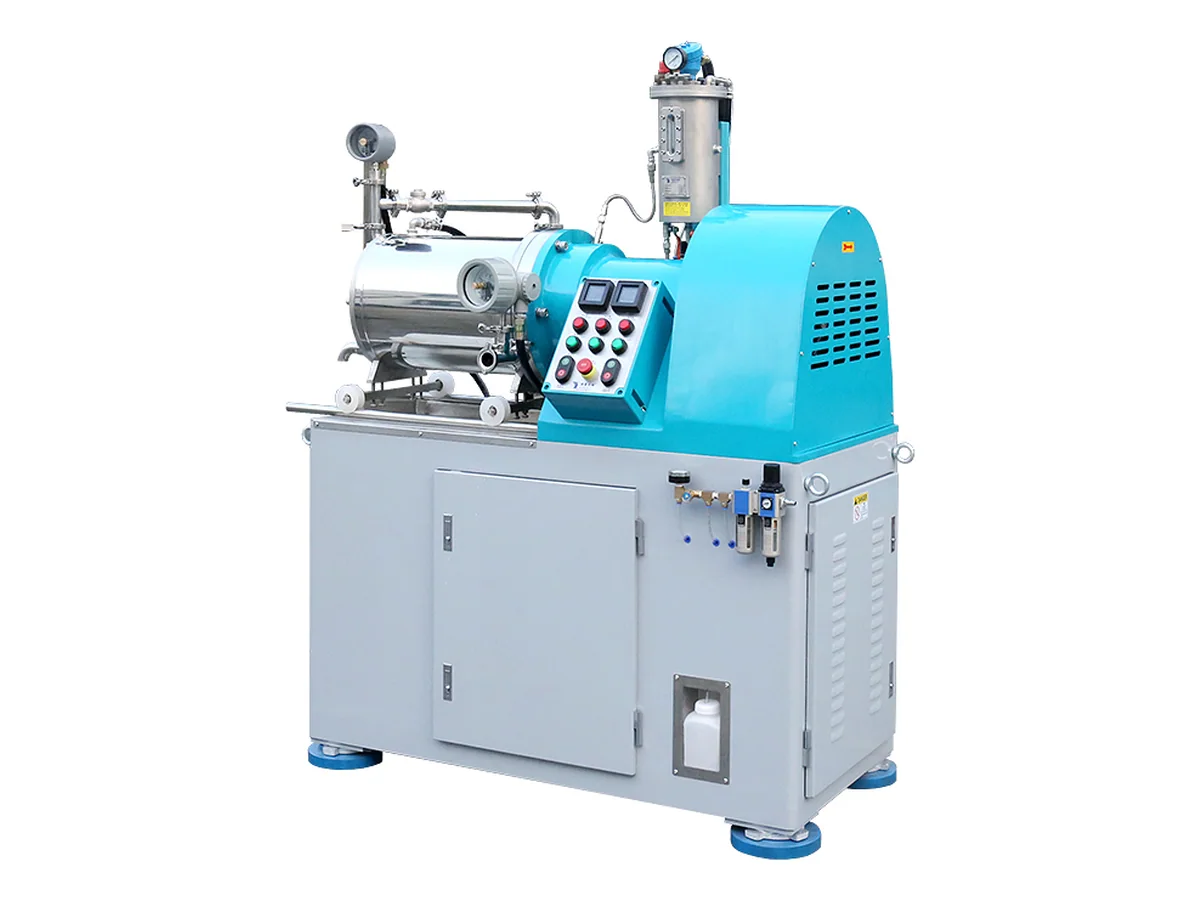
Same chamber idea, different material handling
The grinding principle is unchanged. What changes is everything around it: a hopper or screw feeds the chamber under pressure instead of a centrifugal pump, the discharge is a screw rather than a screen, and the cooling has to work harder because the material itself cannot carry heat away.
This is why a "high viscosity mill" costs more than the standard model with a bigger motor. You are buying the feed and discharge, not the grinding.
Three symptoms that mean yes
Your pump cavitates
The feed pump runs but flow drops to nothing. That is not a pump fault — the material has a yield stress the pump cannot overcome.
You are diluting to mill
If the recipe says 75 % solids and you mill at 55 % then thicken afterwards, you are paying for solvent, tank volume and drying. That is the real cost of not having this machine.
The chamber heats unevenly
Thick material does not convect. Hot spots near the rotor, cold material at the wall. Forced cooling and the right feed rate are the fix; a bigger jacket is not.
If none of these is true, you do not need this machine. A standard PM-M with the right pump will out-perform it on cost and on throughput. We would rather tell you that now.
Hopper, screw, or progressive cavity — this is the choice
| Feed type | Handles | Weak point | Choose when |
|---|---|---|---|
| Hopper + gravity | Very stiff paste, >100 000 cP | Flow varies with level; needs a ram or agitator | Small batches, product you can shovel |
| Screw / auger | Semi-solid, 20 000 – 100 000 cP | Wear on the screw; pulsating flow | Continuous, consistent paste |
| Progressive cavity | 5 000 – 50 000 cP | Stator life; sensitive to hard particles | The upper end of what still pumps |
| Standard centrifugal | < 5 000 cP | Dies immediately above that | You do not actually have a high-viscosity problem |
PM-V series
| Model | Viscosity range | Chamber volume | Motor power | Feed | Discharge |
|---|---|---|---|---|---|
| PM-V10 | 10 000 – 60 000 cP | 10 L | 15 kW | Screw | Screw |
| PM-V30 | 10 000 – 80 000 cP | 30 L | 30 kW | Screw or hopper | Screw |
| PM-V60 | 20 000 – 100 000 cP | 60 L | 55 kW | Hopper with ram | Screw |
Viscosity figures are indicative ranges for this class of machine. Real behaviour depends on whether your material is shear-thinning — a paste that looks stiff in a bucket may pump fine, and vice versa.
What to send us
| What | Why it changes the answer |
|---|---|
| Solids loading, % by weight | The single best predictor of whether you need this machine |
| Viscosity at your milling temperature | Bucket estimates are fine; a rheology curve is better |
| Whether it is shear-thinning | Decides feed type more than the number does |
| Target fineness | High viscosity and sub-micron together is a hard combination |
| Current process | If you dilute before milling, tell us the dilution ratio — that is the money figure |