Basket Mill — One Vessel, No Pump, No Loop
The basket goes into your existing tank and grinds in place. That single fact removes the pump, the hoses and most of the cleaning — and caps your throughput.
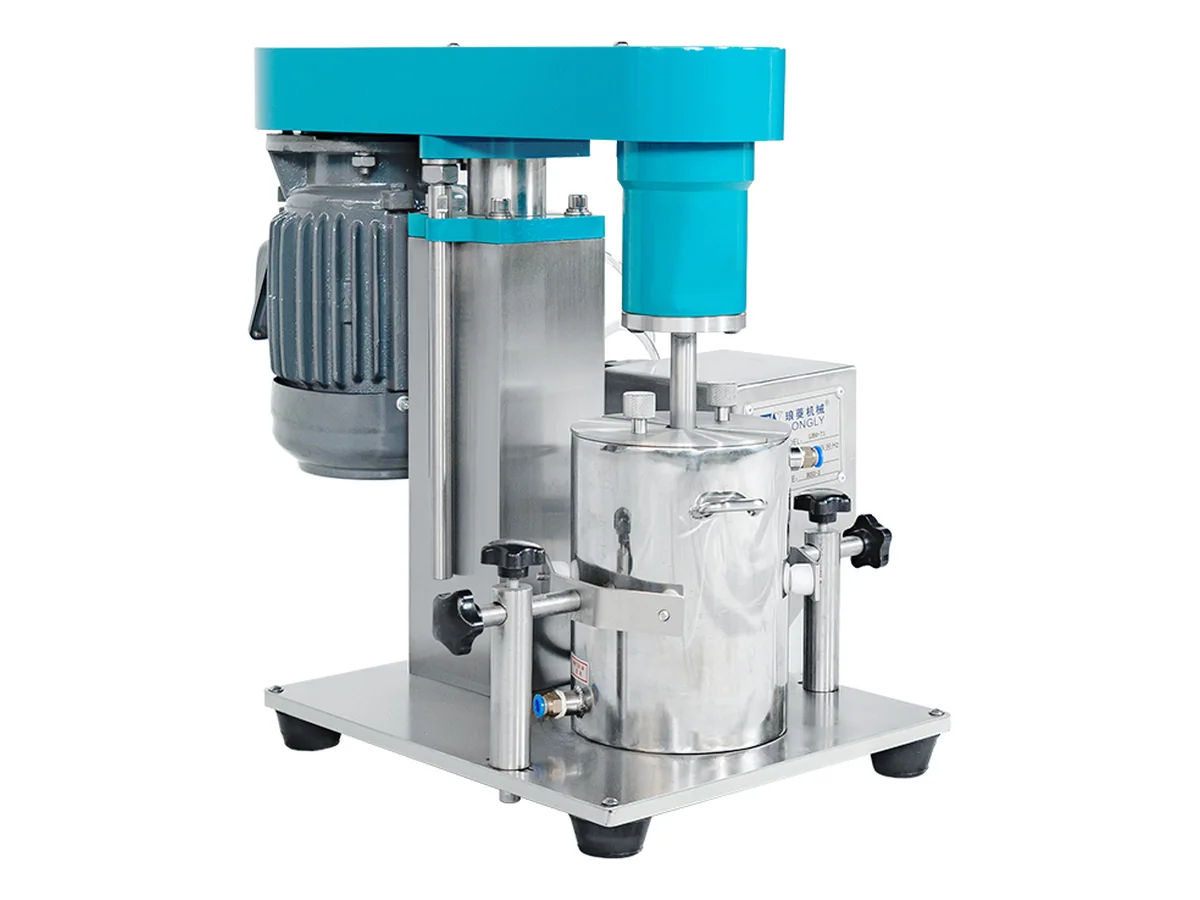
What a basket mill actually is
A hollow cylinder filled with grinding media, lowered into a batch tank. Material is drawn up through the media at the bottom and returns to the batch through slots in the top. The batch circulates — the machine does not.
Almost all the cleaning is done by lifting the basket out. That is the entire appeal: your changeover time is the time it takes to lift a basket and hose it down.
Basket or horizontal recirculation — pick by which constraint hurts more
These two machines are not competitors on fineness. They are competitors on changeover time versus throughput. Almost every wrong purchase comes from comparing them on the wrong axis.
| PM-B basket | PM-M horizontal | |
|---|---|---|
| How material moves | Batch circulates through a stationary basket | Product is pumped through a mill and back to the tank |
| Extra equipment needed | None — one tank, one machine | Feed pump, hoses, instrumentation, level control |
| Changeover / cleaning | Minutes. Lift out, rinse, done | Flush the whole loop — pump, hoses, chamber, seals |
| Tightest fineness | Practical floor around D90 5 – 10 µm | Sub-micron and below, comfortably |
| Throughput ceiling | Limited by batch size and how long one batch takes | Continuous — scales with pump rate |
| Dead volume / loss | One tank's worth of heel | Loop holdup, always more than you expect |
| Best for | Many formulations, small batches, frequent colour changes | Few products, high volume, demanding fineness |
The honest test: count changeovers per week. If you clean the machine more often than you wear out the media, a basket mill will pay for itself in labour alone. If you run one product for weeks, it will not — you are just buying a slower mill.
Three cases where a basket mill is the wrong answer
You need sub-micron
Basket geometry does not let you run very small media efficiently. Below roughly one micron, the honest answer is a horizontal nano mill — we will say so rather than sell you a basket mill that will not get there.
You are continuous
If the plant runs 24 h on one formulation, batch logic is pure overhead. You want a pump and a loop, not a basket going up and down.
Your batch is enormous
Above roughly 2 000 L per batch the basket diameter and the tank geometry stop being practical, and a horizontal mill with a loop is both cheaper and faster.
PM-B series
| Model | Batch range | Motor power | Media | Target fineness | Discharge |
|---|---|---|---|---|---|
| PM-B15 | 50 – 200 L | 15 kW | 1.0 – 2.0 mm | D90 10 – 25 µm | Lift-out basket |
| PM-B30 | 200 – 500 L | 30 kW | 0.8 – 1.6 mm | D90 8 – 20 µm | Lift-out basket |
| PM-B45 | 500 – 1 000 L | 45 kW | 0.8 – 1.4 mm | D90 5 – 15 µm | Lift-out basket |
| PM-B-V | 100 – 1 000 L | 30 – 55 kW | 0.8 – 1.6 mm | D90 5 – 15 µm | Vacuum / sealed version |
Model figures are typical for this configuration — the binding specification comes with your quotation. A range we can stand behind is more useful than a figure that looks precise and is not.
What we need from you to specify one
| What | Why it changes the answer |
|---|---|
| Batch size, in litres | Sets basket diameter and motor size |
| Target fineness (D50 / D90) | Decides whether a basket mill can do it at all |
| Viscosity or solids loading | Sets whether the batch will turn over properly |
| Number of formulations per week | This is the number that justifies the machine |
| Solvent / water based | Seal and wetted-material selection |
No free sample? Fine. Send 1–2 L of material and we will run it on the lab basket mill and send back a particle size curve. If you cannot ship material, send the spec sheet and a photo of your current tank — we can still tell you whether this is the right machine before you spend anything.