Pin-Type Nano Bead Mill
The pin rotor is what makes a nano mill grind rather than pump. It is the configuration we start from for low-to-medium viscosity slurry with a sub-100 nm target — and the one we will talk you out of if micron is enough.
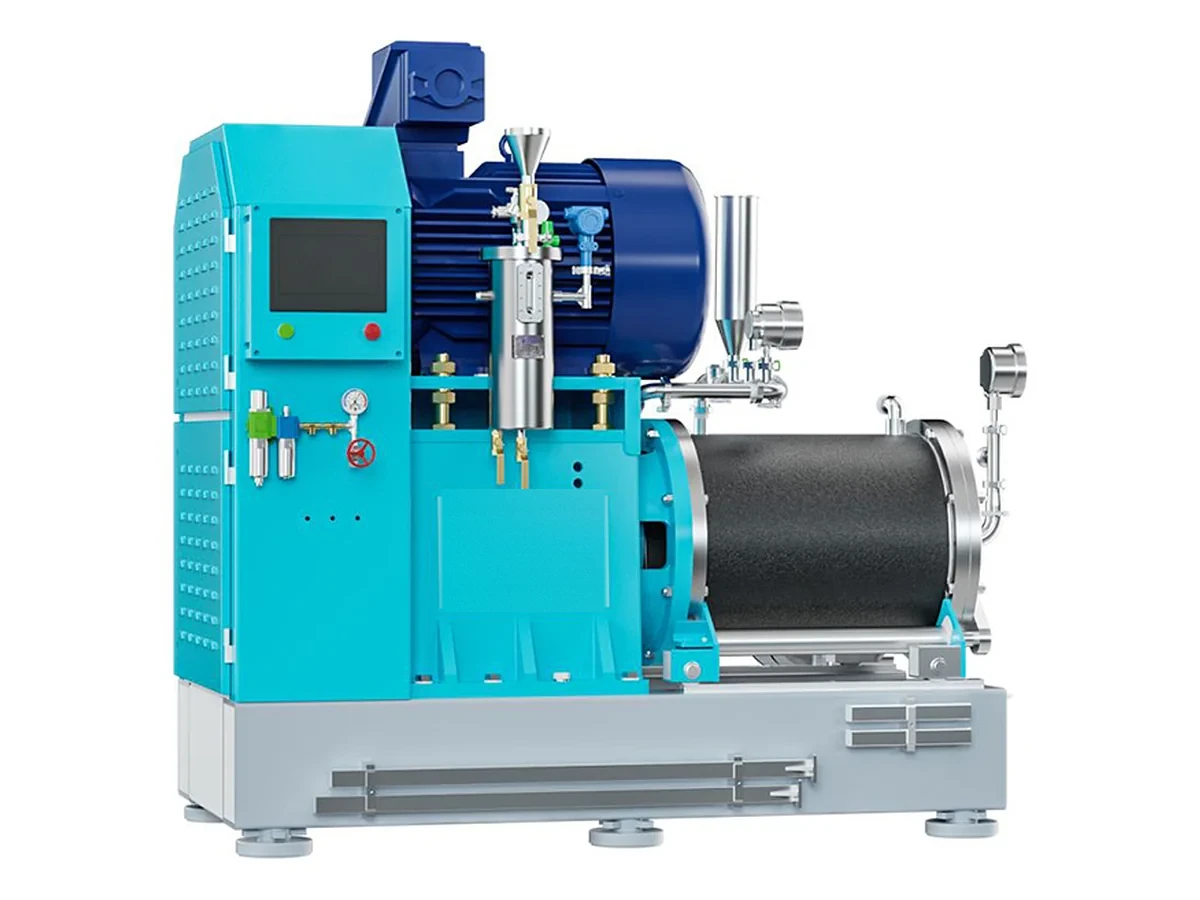
If you are making one of these, this is the right machine
Pin geometry earns its price when the problem is the tail of the distribution — the last few percent of particles that will not break. These are the six cases we are asked about most.
| What you are making | The problem people arrive with | Why the pin rotor helps |
|---|---|---|
| Inkjet pigment dispersion | Median is on spec but the D90 tail will not close — printheads drop out and banding comes back | The pin field gives a narrow spread of residence times, so the tail closes instead of being smeared through |
| Li-ion cathode or anode slurry | Metal contamination and heat damage to the binder during dispersion | Ceramic or PU wetted parts, and a fully jacketed chamber that takes heat out at the wall |
| CNT / graphene conductive paste | Bundles survive the pass — shear never gets high enough to unbundle them | Local shear inside the pin gap is higher than a disc can reach at the same tip speed |
| High-transparency pigment | Colour strength plateaus, so more pigment gets added to compensate | Fineness near 100 nm with a narrow distribution gives more tinting strength per kilogram |
| API nanosuspension | Cleaning validation, and cross-batch carry-over in a chamber full of dead corners | Open chamber with no hidden surfaces; single-product campaigns and CIP are practical |
| Ceramic inkjet ink | Media wear shows up as contamination in the finished ink | Ceramic wetted parts, and low-wear media in the 0.1 – 0.3 mm range |
If yours is not on the list, the question is still the same two: what is your target D90, and what is actually in the slurry. Everything else follows from those.
What you are actually paying for
Four things separate a nano mill from a bead mill with a smaller chamber. Each one exists because of a specific way the process fails.
Pin and rod-pin rotor
- Feature
- Pins stand out from the rotor, with matching pins on the chamber wall. The slurry is forced through that pin field on every revolution.
- Advantage
- There is no low-shear zone around the shaft. Every particle crosses the same energy field, so the distribution narrows instead of spreading.
- Benefit
- You reach the target D90 in fewer passes — which means less specific energy, and less heat for every tonne you grind.
Gap separator, not a screen
- Feature
- An annular gap holds the media back. There is no mesh anywhere in the product path.
- Advantage
- Nothing to blind and nothing to tear, including at 0.05 mm media.
- Benefit
- You can actually run sub-0.1 mm media continuously. Small media is the only route below 100 nm, and a blinding screen is what stops most people from using it.
Cooling where the heat is made
- Feature
- Full jacket on the chamber, with a cooled rotor available as an option.
- Advantage
- Heat leaves through the wall at the point where it is generated, instead of being carried out with the product.
- Benefit
- You can push tip speed for fineness without cooking a temperature-sensitive binder or an API.
One geometry, several sizes
- Feature
- The same rotor and separator geometry runs from the 5 L unit to the 150 L unit, at the same tip speed.
- Advantage
- The residence-time distribution at 5 L and at 150 L is the same shape.
- Benefit
- What you prove on a sample is what the production machine does — you buy capacity without re-qualifying the formulation.
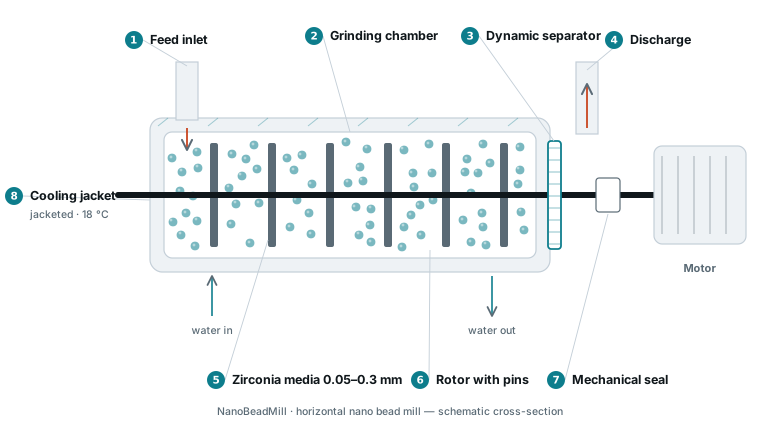
PM-NP models and working envelope
PM-NP is the pin configuration of the PM-N series, so the sizes match the series: PM-NP5, PM-NP15 and PM-NP30 below, with PM-NP60 and PM-NP150 quoted on request.
| Model | Chamber volume | Motor power | Media range | Throughput | Target fineness |
|---|---|---|---|---|---|
| PM-NP5 | 5 L | 11 kW | 0.05 – 0.3 mm | 2 – 20 L/h | D90 < 100 nm |
| PM-NP15 | 15 L | 22 kW | 0.05 – 0.5 mm | 10 – 60 L/h | D90 < 100 nm |
| PM-NP30 | 30 L | 37 kW | 0.1 – 0.5 mm | 30 – 150 L/h | D90 < 100 nm |
Model figures are typical for this configuration — the binding specification comes with your quotation. Throughput in particular depends more on your slurry than on the chamber, so treat the figure as a starting point, not a guarantee.
Media size sets the floor on fineness
Rule of thumb: the fineness you can reach sits between 1/1000 and 1/500 of the bead diameter. No amount of tip speed moves that floor.
| Media diameter | Fineness you can reach | What it is usually for |
|---|---|---|
| 0.05 mm | D90 50 – 100 nm | Nano dispersions, CNT and graphene, pharmaceutical suspensions |
| 0.1 mm | D90 100 – 200 nm | High-end pigment, inkjet ink, transparent iron oxide |
| 0.3 mm | D90 0.3 – 1 µm | Coatings, gravure ink, LFP cathode slurry |
| 0.6 mm | D90 1 – 3 µm | General industrial coatings — a PM-M job, not this machine |
| 1.0 mm | D90 3 – 10 µm | Mineral slurry, agrochemical SC — a PM-M or PM-X job |
PM-NP is specified for 0.05 – 0.3 mm media. Above that it is a micron mill, whatever the nameplate says — which is why the last two rows point at a different series.
Common to every PM-NP
- Wetted parts: SS316L, silicon carbide, zirconia or polyurethane, chosen by your contamination limit
- Separator: gap type, slot, no screen in the product path
- Cooling: full chamber jacket, chilled water, product outlet target
- Seal: double mechanical seal with barrier fluid
- Control: PLC + HMI, recipe storage, temperature and pressure interlocks
- Options: ATEX configuration, cooled rotor, ceramic rotor, CIP connections
When this is the wrong machine
We would rather say this now than after commissioning. If any of these four describe you, the machine you want is somewhere else on this site.
You need 1 – 5 µm, not nano
A disc mill gets there with larger media, less energy and a lower price. Buying nano capacity you do not need is the most common mistake we see in this category.
Micron bead mill →Your material is a paste, not a slurry
Above roughly 30,000 – 50,000 cP a horizontal nano chamber will not move it, whatever the motor size says on the nameplate.
High-viscosity mill →Throughput is the bottleneck, not fineness
Check pre-dispersion before you buy a bigger mill. A better disperser upstream is usually the cheaper way to more tonnes per shift.
Dispersion & mixing →You grind batches, not a stream
If cleaning time dominates and every batch is a different formulation, a single-vessel basket mill avoids the pump, the loop and the flush between products.
Basket mill →One case is not a different machine but a different build: if contamination is the constraint rather than fineness, the same mill is available as PM-NC with all-ceramic wetted parts.
Before you buy, send us a kilogram
We run your material on a PM-NP in the configuration we would quote, and send back the particle size curve with the model and media we used. No charge, and the report is yours whether you buy or not.
Send 1 – 2 kg of your material
Slurry if you have it; powder plus the carrier you intend to use if you do not. We will send the address and the customs description to use, so it clears without a hold.
We run a size-reduction series
On a PM-NP in the configuration we would actually quote. D10 / D50 / D90 after each pass, plus product temperature, so you can see where the curve flattens.
You get the curve, the model and a budget price
Whether or not you buy. The report is yours to show your own board or your customer.
Grinding something else?
PM-NP covers sub-100 nm in low-to-medium viscosity material. Everything else we build sits in seven other configurations — pick by what your material does, not by model number.
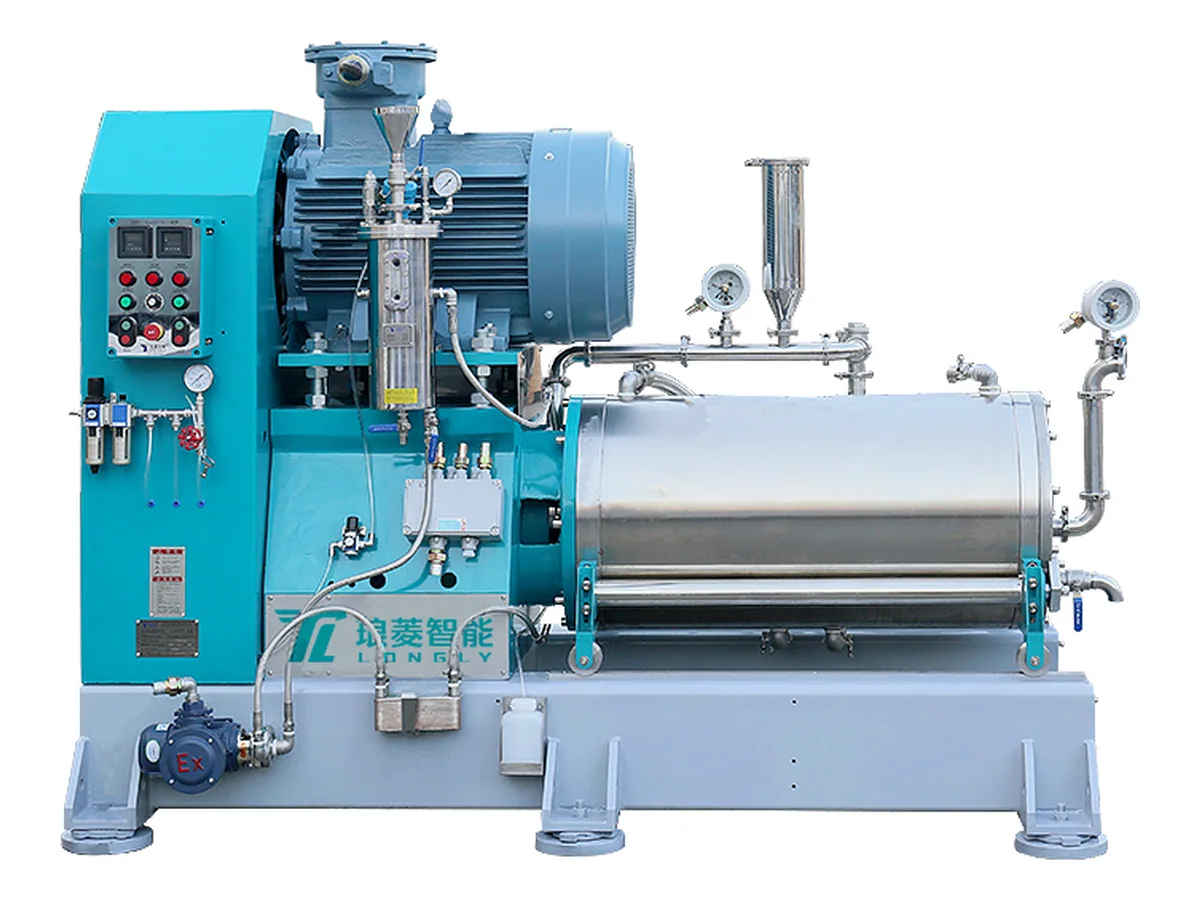
Micron / Sub-micron Bead Mill
The production workhorse for coatings, inks and general sub-micron work.
Choose it when: Disc type for general work; pin type when you need more energy per pass.
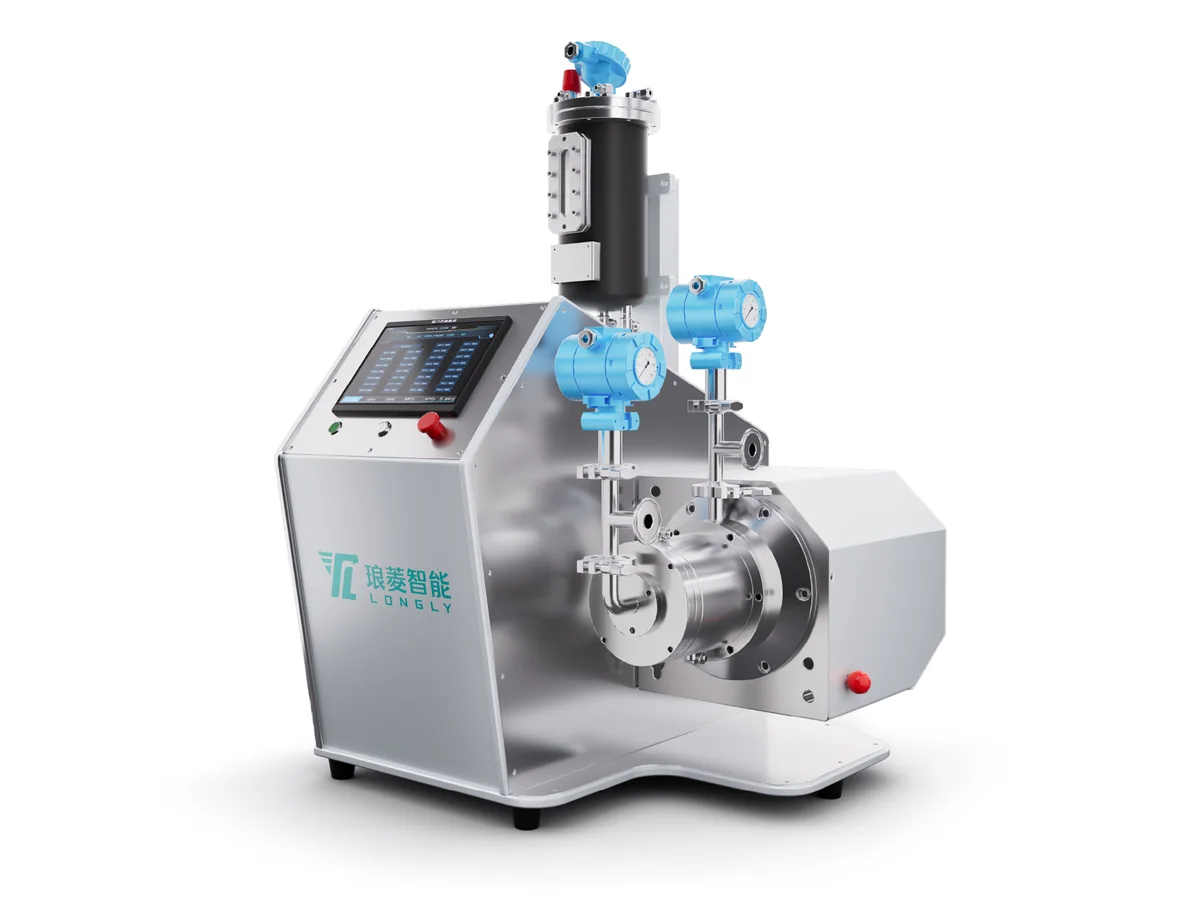
Lab & Pilot Mill Most requested
Same media and tip speed as the production machine, so results scale.
Choose it when: Start here if you need to prove a target before buying capacity.
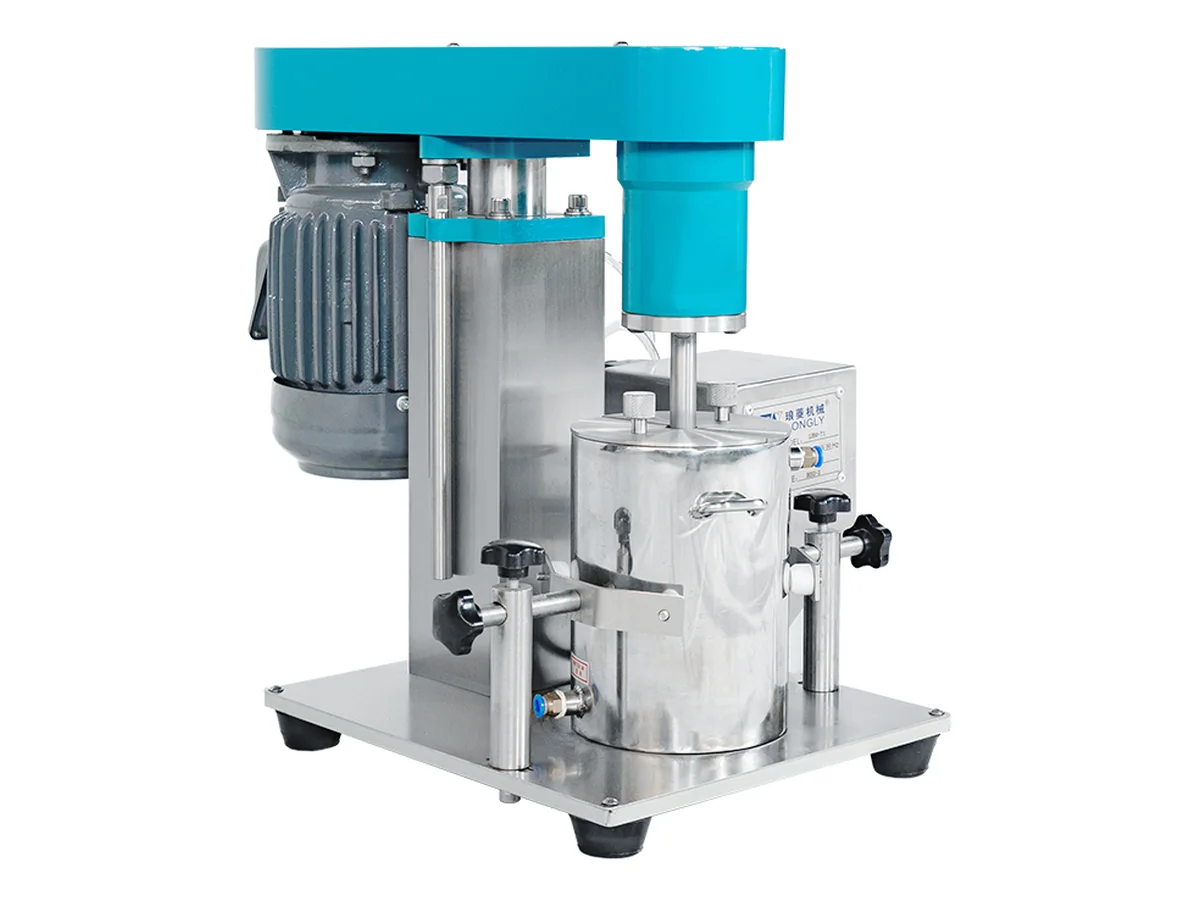
Basket Mill
Single-vessel dispersion — no external pump or recirculation loop.
Choose it when: Best for many formulations in small batches, or when cleaning time dominates.
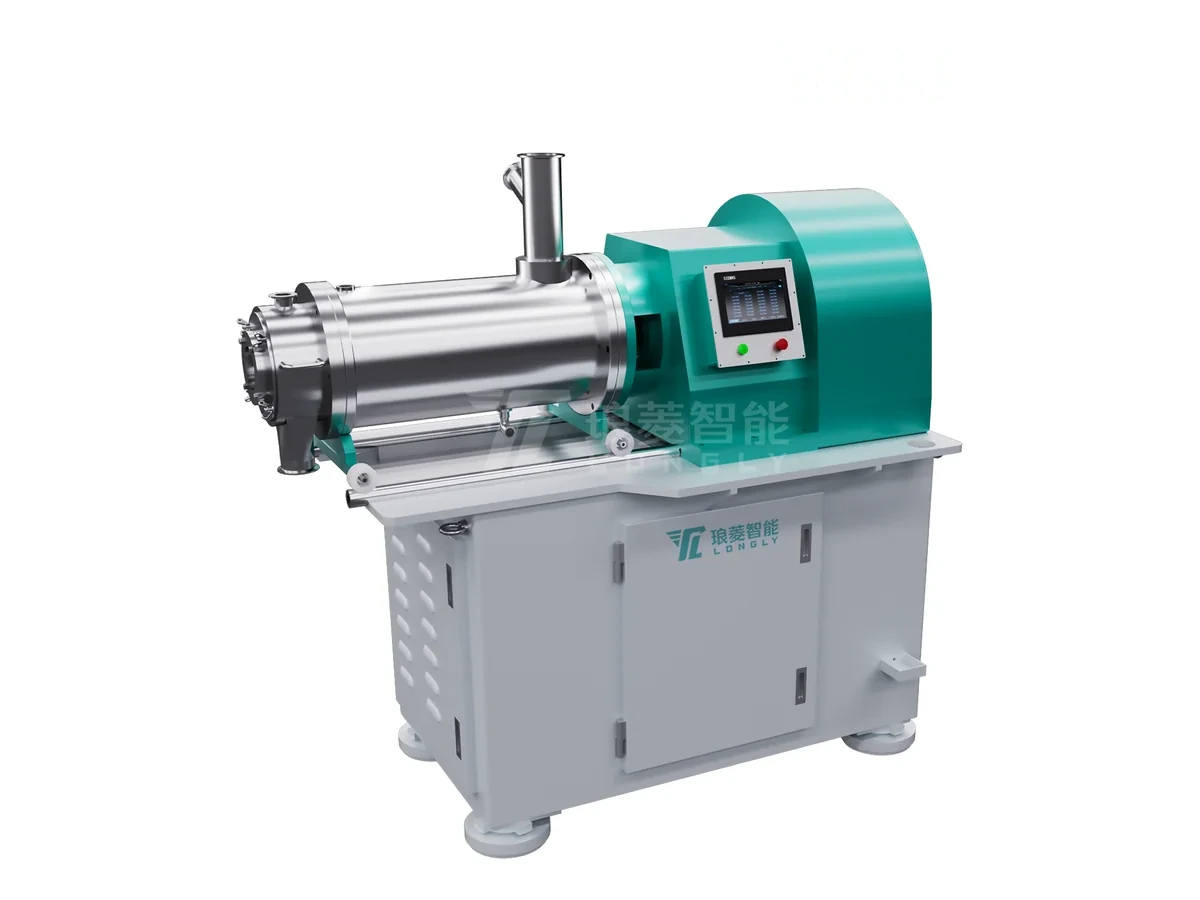
Dry Grinding Mill
Dry micronisation with air classification and dust collection.
Choose it when: For powders that cannot be processed wet — no drying step downstream.
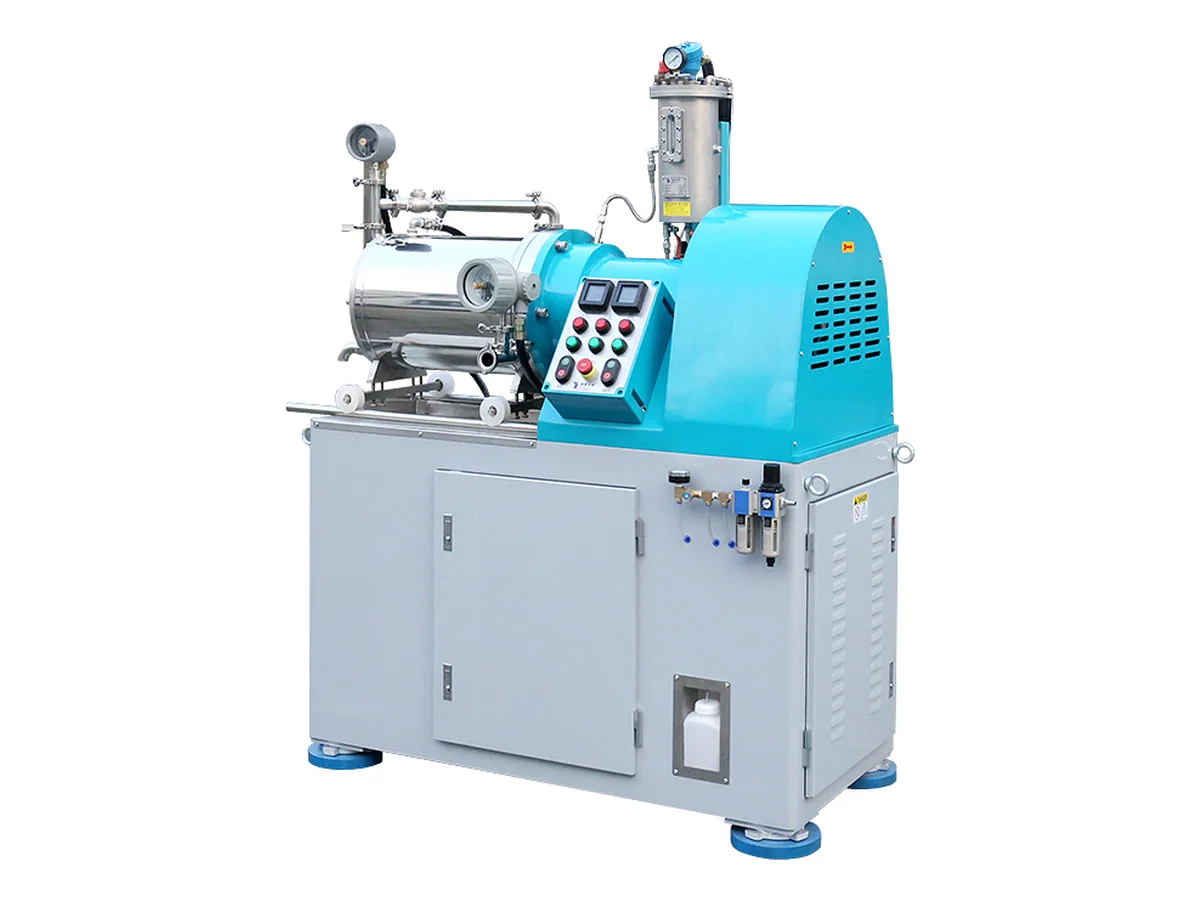
High-Viscosity Mill
Built for high-solid and high-viscosity material, with screw discharge.
Choose it when: For pastes and highly loaded compounds a standard mill will not move.
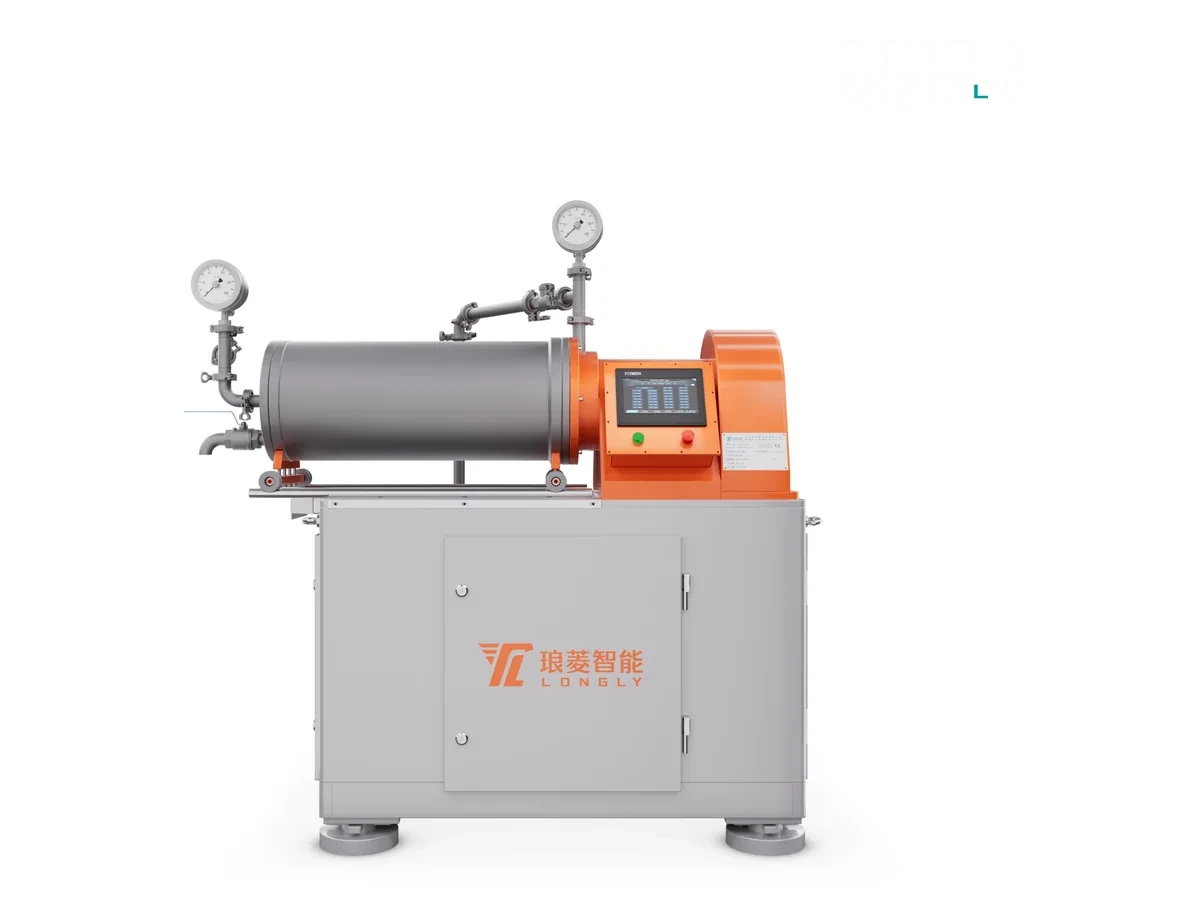
Mining & Large-Scale Mill
Stirred media mills sized for mineral slurry at plant throughput.
Choose it when: Selected on throughput and media consumption, not on fineness alone.
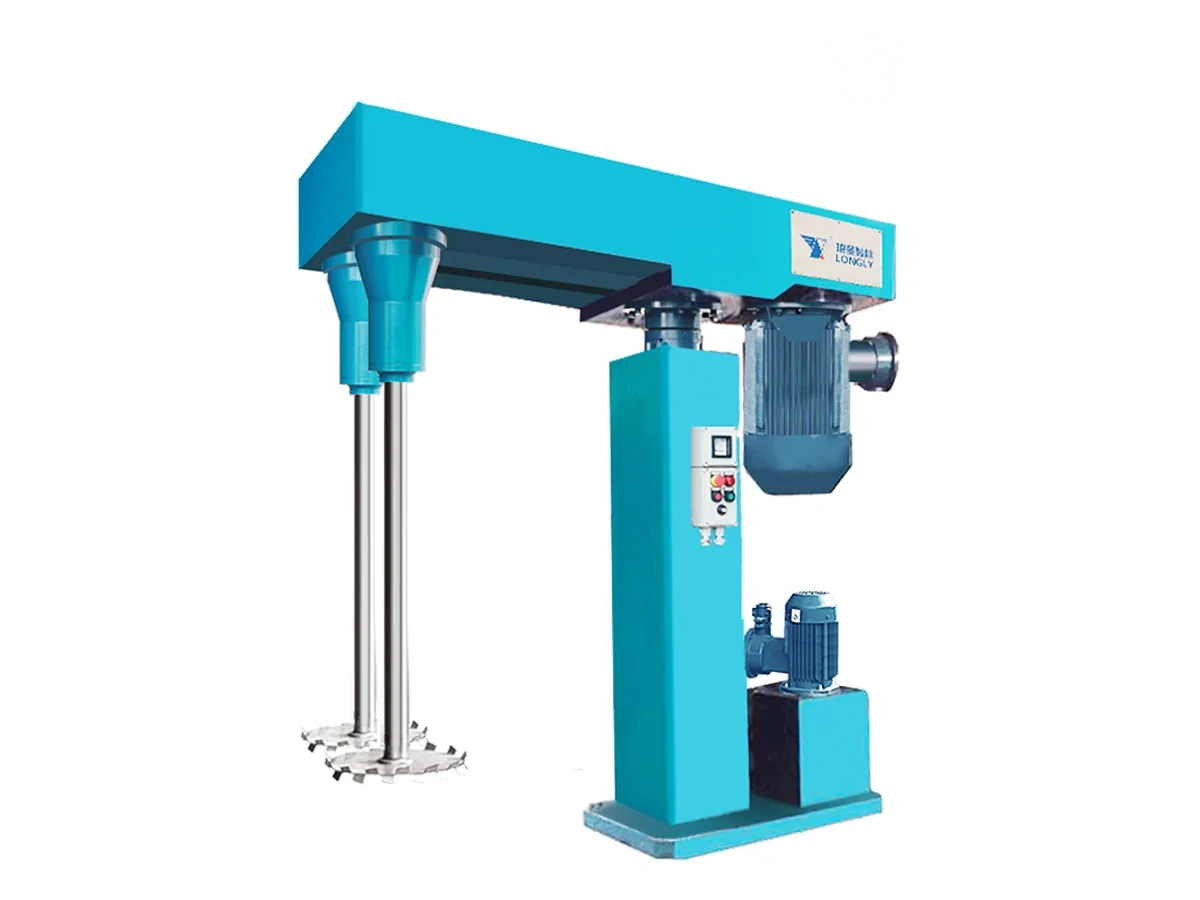
Complementary Equipment
Three-roll mills, inline pre-dispersion, mixers and spray dryers.
Choose it when: Often the cheapest throughput gain is better pre-dispersion, not a bigger mill.
All eight configurations
The complete index — wet and dry, 0.5 L laboratory units through to plant-scale stirred media mills.
Open the equipment index →Before you ask
Do I need nano at all?
Often not. If D90 between 1 and 5 µm solves the application, a micron mill will do it with larger media, lower energy and a lower price. We ask for the target D90 and the reason behind it before quoting anything.
What media size should I start with?
Work backwards from the target, not forwards from the machine. Media size sets a floor on achievable fineness — you cannot reach 100 nm with 0.5 mm beads, whatever the tip speed. The chart above is the rule we use.
Single pass or recirculation?
Recirculation for most pigment, ink and battery work, because it gives a tighter distribution per unit of energy. Single pass is used where the formulation cannot tolerate another trip through the pump and the tank.
Can it run solvent-based product?
Yes, in the ATEX / explosion-proof configuration, with the seal and the electricals specified for the solvent class you declare. Tell us the solvent and the flash point at the enquiry stage — it changes the build, not just the paperwork.
How small a sample can you test?
A few hundred millilitres is enough for the laboratory unit, which uses the same media and tip speed as production. One to two kilograms lets us run a full series on the production configuration instead.
Not sure nano is what you need?
Send the target D90 and what is in the slurry. If a micron mill will do the job we will say so — it is cheaper for you, and it is a shorter commissioning for us.